
P03 Locke
- 20 Posts
- 511 Comments

The Chinese models are significantly better and will outcompete the models from the US, it was just a matter of people realizing that.
Maybe not as good as Claude, but they are good enough, and open-source, and free. The US market is going to learn the hard way why open-source curbstomps greedy bullshit.
OpenAI will be the first to fall, and then better players like Claude will be forced to release more open-sourced models.
they will lobby for tariffs or banning Chinese models outright also seems to be coming true.
Then it’ll just come from Germany or France or elsewhere. It doesn’t take millions of dollars to train a good model, despite these US companies pretending that it does.
 English
- •
- www.youtube.com
- •
- 18d
- •

That would involve a level of risk that a corporation that bought out a corporation that bought out Blizzard is not allowed to take. But, of course, they will gladly take billions of dollars and light it on fire for shitty decisions like the Metaverse or laying off tens of thousands of their own staff.
It’s not even fair to call them Blizzard any more. They are Microsoft. Any time somebody boots up WoW, it’s Microsoft World of Warcraft. Just like it’s Microsoft Minecraft, Microsoft Call of Duty, Microsoft Fallout, and Microsoft DOOM.
Stop calling them by ancient names like they haven’t been fully absorbed into the mega-corporation. Blizzard is gone, and has been for at least a decade.
That’s the thing. It’s easy to make something that obviously looks like AI. Slop is slop because it’s lazy and takes five minutes to make. Corpos love slop because they always want to take the minimum time possible to make anything.
However, with a bit more effort, you can make something that doesn’t look like AI at all, and still took less time to make than doing it manually.
With all of this boundary setting, people are just going to hide it better. More hostility just means less transparency. It’s already happening.
Calling something “eurojank” is implying it was made in France, Belgium, Spain, Denmark, Italy, Greece, or any number of Western European countries.
Nobody calls it “eurojank”. They call it “slavjank”. Slavic counties. Like for example, Ukraine, which, hey, is exactly where Stalker developer Volodymyr Yezhov comes from.
The game is literally about the Chernobyl exclusion zone in Ukraine. Don’t bitch about “geofencing” a genre of games when Stalker geofences its own fictional universe.
It’s like an anime creator bitching about people associating it with Japan when the stories are all strangely focused on Japan for some reason.
That said, do you believe that using generative AI in this case (for prototyping and rapid iteration/visualization of intermediate/non-final design concepts) is worse than, say, artists looking at the freely available online portfolios of other artists for inspiration, provided that they generate the final designs entirely by themselves?
That would require a nuanced answer that most of these plebes don’t have.
These are US and Canada productions. If you’re wondering why game X cost so much less, it was probably made elsewhere
Stardew Valley was made in the US. Same with Terraria, Axiom Verge, Outer Wilds, Balatro, Risk of Rain, Undertale, The Stanley Parable, Hyper Light Drifter, and a shit ton of other games.
If you’re wondering why game X costs so much less, it was probably made by a indie studio!
Jason is just lying at this point, if he believes otherwise.

Or maybe even every session?
Fuck that… every frame.
Although, that was the experience with Stable Diffusion a few years ago. WAN Video is good enough for remembering the face during the course of the processed length (4-5 seconds or so). But, as soon as it needs any sort of object permanence, like when the face is hidden, suddenly, it doesn’t know what it was looking at any more. Seems like a solvable problem with reference images. I doubt NVIDIA thought that far, though.
I didn’t just ask the ai to do something I new which library I wanted it to use and new what I wanted it to interface with and new exactly what I wanted it to do.
I have no understanding of the language
No shit… you don’t even have an understanding of the English language. No wonder the LLM didn’t understand you.
If you let the AI do the thinking for you, then you’re building AI slop.
No, for major projects, you start out with a plan. I may spend upwards of 2-3 hours just drafting a plan with the LLM, figuring out options, asking questions when it’s an area I don’t have top-familiarity with, crafting what the modules are going to look like. It’s not slop when you’re planning out what to do and what your end result is supposed to be.
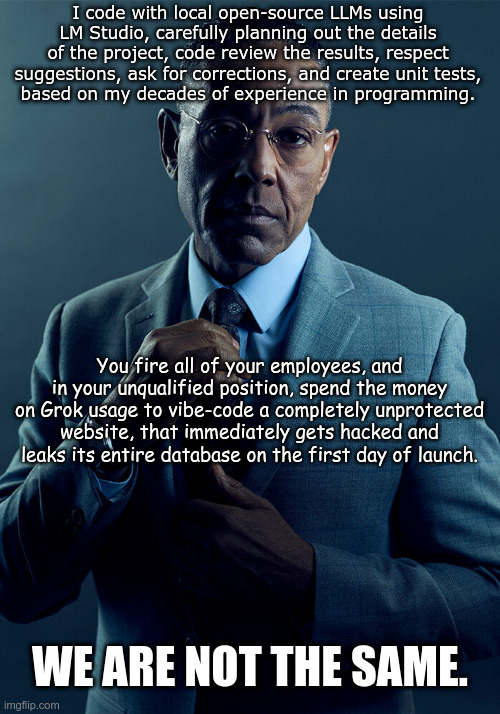
People who talk this way have zero experience with actually using LLMs, especially coding models.
We would be faaaaaar less hostile towards copyrights if we had a regular source of RECENT public domain coming out every year.
I’m not saying that it would make GPL or OSS licenses useless. I’m just saying that the motivation and need for those licenses are because we don’t live in a society where freely available media and data are much more commonplace.
but in the end it boils down to being a text prediction machine.
And we’re barely smarter than a bunch of monkeys throw piles of shit at each other. Being reductive about its origins doesn’t really explain anything.
I trust the output as much as a random Stackoverflow reply with no votes :)
Yeah, but that’s why there’s unit tests. Let it run its own tests and solve its own bugs. How many mistakes have you or I made because we hate making unit tests? At least the LLM has no problems writing the tests, after you know it works.
Then they stop bothering to review the code.
This happens with human code reviews all the time.
“I don’t really understand this code, but APPROVE!”
“You need this thing merged today? APPROVE!”
“This code is too long, and it’s almost my lunch break. APPROVE!”
Over and over and over again. The worse thing you can insult me with is take code I spend days working on and approve it five minutes after I submitted it to you.
the problem is that if I have to nanny it to make sure it doesn’t make a mistake then how is it a useful product?
When was the last time you coded something perfectly? “If I have to nanny you to make sure you don’t make a mistake, then how are you a useful employee?” See how that doesn’t make sense. There’s a reason why good development shops live on the backs of their code reviews and review practices.
The math ain’t matching on this one.
The math is just fine. Code reviews, even audit-level thorough ones, cost far less time than doing the actual coding.
There’s also something to be said about the value in being able to tell an LLM to go chew on some code and tests for 10 minutes while I go make a sandwich. I get to make my sandwich, and come back, and there’s code there. I still have to review it, point out some mistakes, and then go back and refill my drink.
And there’s so much you can customize with personal rules. Don’t like its coding style? Write Markdown rules that reflect your own style. Have issues with it tripping over certain bugs? Write rules or memories that remind it to be more aware of those bugs. Are you explaining a complex workflow to it over and over again? Explain it once, and tell it to write the rules file for you.
All of that saves more and more time. The more rules you have for a specific project, the more knowledge it retains on how code for that project, and the more experience you gain in how to communicate to an entity that can understand your ideas. You wouldn’t believe how many people can’t rubberduck and explain proper concepts to people, much less LLMs.
LLMs are patient. They don’t give a shit if you keep demanding more and more tweaks and fixes, or if you have to spend a bit of time trying to explain a concept. Human developers would get tired of your demands after a while, and tell you to fuck off.
However, for more specialized code, I would be concerned. It would likely not function at all without editing, and if it did function it probably wouldn’t be optimized or secure.
That’s not completely true. Claude and some of the Chinese coding models have gotten a lot better at creating a good first pass.
That’s also why I like tests. Just force the model to prove that it works.
Oh, you built the thing and think it’s finished? Prove it. Go run it. Did it work? No? Then go fix the bugs. Does it compile now? Cool, run the unit test platform. Got more bugs? Fix them. Now, go write more unit tests to match the bugs you found. You keep running into the same coding issue? Go write some rules for me that tell yourself not to do that shit.
I mean, I’ve been doing this programming shit for many decades, and even I’ve been caught by my overconfidence of trying to write some big project and thinking it’s just going to work the first time. No reason to think even a high-powered Claude thinking model is going to magically just write the whole thing bug-free.
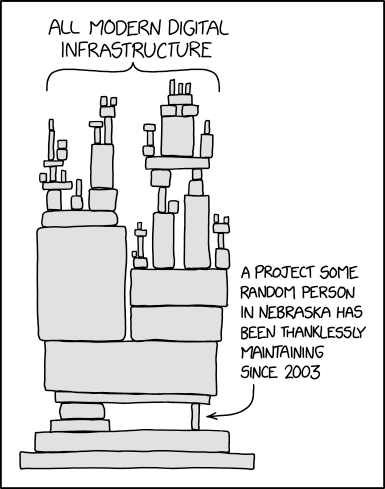
If a FOSS project is archived/unmaintained, for a large enough project, someone else will pick up where the original left off.
No, they won’t. This line of thinking is how we got the above.
Their line of work is thankless, and nobody wants to do a fucking thankless job, especially when the last maintainer was given a bunch of shit for it.
In fact, I would argue that specifically designating code as machine written is detrimental to code review, because there will be a subconscious bias among many reviewers to only focus on reviewing the machine code.
Oh, it’s more than subconscious, as you can see in this thread.
Lutris developer makes a perfectly sane and nuianced response to a reactionary “is lutris slop now” comment, and gets shit on for it, because everybody has to fight in black and white terms. There are no grey opinions, only battle lines to be drawn to these people.
What? Are you all going to shit on your lord and savior Linus himself for also saying he uses LLMs? Oh, what, you didn’t know?!?
Agreed, I don’t understand people not even giving it a chance. They try it for five minutes, it doesn’t do exactly what they want, they give up on it, and shout how shit it is.
Meanwhile, I put the work in, see it do amazing shit after figuring out the basics of how the tech works, write rules and skills for it, have it figure out complex problems, etc.
It’s like handing your 90-year-old grandpa the Internet, and they don’t know what the fuck to do with it. It’s so infuriating.
Probably because, like your 90-year-old grandpa with the Internet, you have to know how to use the search engine. You have to know how to communicate ideas to an LLM, in detail, with fucking context, not just “me needs problem solvey, go do fix thing!”
You could fit all the spent nuclear fuel humanity has ever used into a single swimming pool.
Around the U.S., about 90,000 tons of nuclear waste is stored at over 100 sites in 39 states, in a range of different structures and containers.
I’m fairly sure a swimming pool can’t hold 90 Kilotons of nuclear waste.
Also, not needing enriched uranium is a pretty big deal, considering it’s an expensive process. And just having an enrichment facility is enough for the UN to stop and take notice, start flailing around with their arms in the air, and scream about nuclear weapons projects.
- •
- www.youtube.com
- •
- 1Y
- •

 English
- •
- www.youtube.com
- •
- 1Y
- •





- •
- www.youtube.com
- •
- 2Y
- •




- •
- www.youtube.com
- •
- 2Y
- •







- •
- www.youtube.com
- •
- 2Y
- •

- •
- www.youtube.com
- •
- 2Y
- •

- •
- www.youtube.com
- •
- 2Y
- •

Okay, apparently, the hundreds of thousands of dollars figure was BS.