- 0 Posts
- 81 Comments

They were always going to receive at least some critical acclaim. This is a AA game from a well-known and respected publisher (Kepler Interactive), so it couldn’t have gone entirely under the radar. They had a decent enough marketing budget and initially were included in the Microsoft Gamepass specifically to secure the studio’s financial future in an uncertain market. The game was objectively good so with all that help, by release day there was no way that the game was going to be a complete dud à la Concord, and I recall Broche saying in interviews that profitability was essentially expected even though the stratospheric success was not.
Also they did get “unlucky” because the Oblivion remaster not-so-coincidentally shadow-dropped a couple days before E33’s release. It’s not much of a stretch to say that Microsoft knew the game was good and (mostly unsuccessfully) tried to drown it out.
If E33 was going to truly flop, it would have been earlier in the development process IMO. They could have relinquished voting shares to investors and been forced to “ubisoftify” the game into bland nothingness. Key creatives could have left. Going all-in on UE5 might have been a technical quagmire. But when the game went Gold, there was very little that could have impeded an at least modest amount of success.
Where the industry is truly unforgiving is single A games. There’s too much to keep track and it’s entirely possible for the “media” (journalists, youtubers, streamers, etc.) to miss a very good game. Single A doesn’t pack enough of a punch to force enough eyeballs on trailers to get a critical mass of fan following, and in that context I fully agree that even a perfect game can still be a complete flop.
E33 did not just get lucky. They used a completely different formula.
~10M€ development cycle with 30 full-time devs + outsourcing is one order of magnitude smaller than what the big studios consider to be the “standard”. AA vs AAA.
30-40 hours of main story and no open world keeps the development resources focused and gameplay/story loops tight in a way that can’t be achieved in an “expansive” open world without unfathomable resource expenditure. But modern games from major studios literally cannot get greenlit if “open world” is not in the feature list because execs see it as “standard”.
Smaller budget also means that they did not pour 50 %+ of their capital into marketing, which allows mores resources to be put into the game and lowers the barrier to profitability. That’s an understated issue; AAA games can’t afford to fail, which is why they all end up bland design-by-committee.
Those parts above were not risks Sandfall took, they were actually basic risk mitigation for an indie studio that big studios aren’t doing based on the overstatement that bigger = more chances for “THE hit game” = better.
Where E33 took some risks was with the strong creative vision and willingness to ignore genre trends and focus group feedback (going turn-based and not lowering the difficulty to “baby’s first video game”). But for the cost of 1 Concord a big studio could afford to make 10 E33s at which point it’s really not a matter of “luck” for at least one to be (very) good. E33 would have been profitable with 1 million units sold, it did not even have to be that good.
The industry has absolutely noticed that E33 wiped the floor with their sorry asses, and I predict that in ~5 years we’ll see many more AAs popping up.
Whole industry has been saying that for a while. It’s unsustainable and to a large extend large studios have fallen to the sunk cost fallacy since they are often on 5-10 years development cycles (!), with very rigid schedules (since they rotate development teams).
Now the big studios are going bankrupt/getting sold to MBS while Expedition 33 is doing tricks on their grave (at least relatively, in absolute numbers their sales numbers aren’t high with normies who only play CoD and FIFA).
It’s dumber than that. Capitalism does not demand endless growth from any one company. The overall economy grows, sure, but that may come from other economic sectors. Exxon and Chevron haven’t seen significant growth for a couple decades, because the oil market hasn’t seen significant growth. That does not make them communist. They can just exist at an equilibrium.
Big Tech has a peculiar economic model centered around high fixed costs (R&D) and low marginal costs (digital distribution), which has made a handful of companies unbelievably cash-flush as they reaped insane scale effects. And they simply don’t know what to do with so much cash.
Capitalism is supposed to answer that with a reduction in income from competitive pressure. If something is so profitable to do, someone else will do it cheaper. However, such competition does not exist because neoliberal governments have abdicated their mandate to foster competition through trust-busting and forced interoperability.
That’s not to say capitalism is good or anything. But even within capitalism, what happened with Big Tech was avoidable.
Either way US Big Tech is not capitalist anymore. It’s an autocratic oligarchy with capitalist characteristics.
Akshully both are dubs, but the script and mocap sessions were done in English. On top of that the French dub was outsourced and the game director and lead writer weren’t in the studio like for the English dub, and it shows IMO. Some French lines clearly don’t have the same level of direction as the “canonical” dub.
However I will say it’s still a better dub than most French dubs. I’d argue the bar is on the floor but the francophone dubbing lobby would draw and quarter me for holding such heretic opinions.

That’s one area where you can see it is indie despite the large development cost.
They were published by Kepler Interactive and for some markets Bandai Namco. Neither of which have Ubisoft or EA’s marketing budget which normally makes up something like half of the development budget of a game.
They did have some marketing. I know a lot of French streamers were paid to play the game on launch. But yeah not “in your face for 6 months in front of every YouTube video and inside every happy meal box” like a new assassin’s creed or something.
The category is misnamed. It should be best single A game from an independent studio.
Technically Sandfall is an independant studio. A very well privately funded independant studio founded by industry veterans supported by a great publisher. But no-one is arguing that other games published by Kepler Interactive aren’t independant. And with 30-ish full-time employees Sandfall’s scale is that of an SME, not an Ubisoft/EA/Sony.
The award doesn’t feel right because this middleweight AA category was completely abdandoned the previous decade (which legacy studios are now paying a heavy price for), and “indie” came to mean “single A” because if the material conditions of being an independant company.
At the same time though technological advancements enabled small teams to take on larger and larger projects. “Indie” does not mean what it used to, and Clair Obscur is trailblazing this AA renewal. Award shows simply need to adapt and start restricting entry based on team size or something.
I read people complained that ME1’s character creator was ass. I guess it must have gotten that reputation by being kind of ass for making a dude, because my Shep was a badass bitch. Voice actress was on top of things too. She’s by far the most memorable custom character I played.
Until ME3 where they yassified her from a 40-something war veteran to a glossy-skinned 25 year old lifestyle vlogger. Interestingly that made me - a cis man - feel viscerally connected to the injunction to look a certain way for the male gaze, and I got so fucking mad at bioware during that intro cinematic.
So happy to see the game is not dead.
Combat and movement look fun and satisfying, graphics look amazing. So many moody areas, from gritty snowscape to colorful caves. Mojang could learn a thing or five from this trailer.
I do hope there will be more breadth of gameplay especially on the creative side so those promising exploration mechanics do not feel stale after a few hours of running around and blasting skeletons. That’s one thing mojang does get right, if anything they have too much breadth and not enough depth.
Not sure about the ease of movement when scaling multiple blocks. Figuring it how to get from point A to point B with the limited movement options is a core part of most Minecraft gameplay loops, especially when caving and/or fighting. Seems they made up for it with good fighting mechanics, but they will have to make up for it in the other gameplay loops as well.
Either way I wish them the best and hope they light a fucking fire underneath mojang’s ass.
EDIT:
This is the original legacy engine from the 2018 trailer, running on a four-year-old build as we push Hytale forward again.
Now hold the fuck up. What do you mean this is the 2018 engine? What the fuck have they been doing the past 7 years? Did they rewrite a whole new engine for no good reason? It looks fucking beautiful and seems to run great! I’m sure they had their reasons, and I don’t think we can draw accurate conclusions by speculating, but the insider perspective on the development cycle must be absolutely wild.
EDIT2: Okay their blog post explains quite a bit more. Seems to paint a picture that Riot wanted the engine to be cross-platform (makes sense for consoles) and they could not make it work with a full rewrite away from their otherwise functional Java/C# engine. Kind of a crazy play on Riot’s part to make Java/C# devs and former minecraft modders write a modern game engine from scratch in C++ if that’s the case. Probably a tough lesson to learn for everyone involved. If only they could learn from an incredibly popular voxel-based building/aventure game that went through the exact same engine rewrite away from a GC VM language and faced similar struggles.
As a PC player, great news that they’re sticking to .NET and Java. It will make modding much easier.

And Hytale got shitcanned!
It’s actually amazing that in an industry so hell-bent on copying successful formulas ad-nauseam (e.g. Quake&Doom spawning the whole genre of First Person Shooters), Minecraft has not seen anything reach the status of spiritual successor in over 15 years of charts-topping sales performance. Not from its own studio, not from its former creator, not with the Late Hypixel Studios.
There are survival games and base-building games and exploration games, but none of them are “Minecraft-likes” in the way that early FPS were “Quake-likes”. CS has Valorant. LoL has Dota. Tekken has Street Fighter. PUBG has Fortnite has Roblox. Minecraft somehow remains truly one-of-a-kind, a gaming UFO that eludes suits looking for a replicable formula. I actually believe Mojang themselves don’t understand why Minecraft works in the first place either, which is why every update seemingly either underwhelms or angers everyone. That game is lightning in a bottle and no-one knows what to do with it.
If Nadella had a stroke so bad he decided to make Minecraft FOSS, I’d be really interested to see what would happen. If any for-profit company was allowed to make direct Minecraft derivatives, I do think we would see a level of creativity and innovation that would dwarf even the already extremely prolific current modding scene.
It’s not even about predictions or estimations - everything’s so many years late everyone stopped counting. They just… don’t seem to understand “scoping”? The pitch is “ultra-realistic life-size universe sandbox simulation” and they keep hitting walls because they’re using tech that’s completely inadequate for the task at hand but they won’t let that deter them. They’ve probably reimplemented every subsystem of the Crysis 3 engine a dozen times by now, and it’s still not anywhere near capable of achieving even a tenth of their ambitions. Fuck, they just very recently got their server meshing thing barely working after like a decade of development (at the cost of rewriting everything again of course).
It’s like watching a team raising billions to build the Burj Khalifa but all they have is a bunch of dry sand and some spoons. Deadlines aren’t really the issue.
“Regular” SDDs can only be done within 5 business days apparently. Not that I would know, my bank certainly doesn’t offer a magic money back button to their private customers, and as I remember it my contract only allows transaction reversal in case of identity fraud, basically.
As far as I can tell, SDDs are a B2B-oriented tool that can only be initiated in particular circumstances such as a merchant being unable to fulfill an order altogether – i.e. when the legal case for a breach of contract is so unambiguous that it isn’t worth either party’s time to go to court. That’s very different from the American thinking of “my hotel room wasn’t as clean as I like it so I’m going to do a chargeback because that’s my Visa-given right”.
What Americans tend to refer to as “fraud protection” is charge back policies, where the payment processor acts as Content Police and revert transactions if they hear the vendor was unfair to their customer (and they usually are on the side of the customer).
My EU bank won’t do that even on my credit card, because it’s insane that one would expect a financial institution to be judge, jury, and executioner in the case of a disagreement over legal services rendered.
Americans have to own up to the uncomfortable fact that dependence on these policies is what keeps the big credit cars companies in power, on top of severely driving up consumer prices (unfairly weighted towards the rich of course who get cashbacks thanks to the obscene money Visa makes on their enormous transaction fees) and being incredibly unfair to small vendors who don’t have the means to meaningfully dispute fraudulent chargebacks.
So do regular fiat payment processors that are beholden to citizens and not faceless shareholders. Wero and Pix for instance.
Democratic governments are supposed to safeguard your ability to exchange legal tender for legal goods and services. The fact that Visa/MC have a duopoly and a stranglehold on the entire online economy is a major governance failure that needs to be rectified ASAP.
Crypto goes a lot further and says no-one, not even the government, should be able to prevent a transaction from taking place. Not necessarily an invalid idea but it does come with some huge unanswered challenges, such as “what happens when someone makes 1B€ through fraud and refuses to hand over the coins” and “how do we even prevent large-scale fraud in the first place”.
I mean, their leader is literally under fire for saying the Epstein files never existed and people should just stop talking about it. Making it illegal to even mention sex trafficking is the next logical step to protect the Dear Leader, because lord knows tackling the real issues wouldn’t end well for him.
It’s actually a more ideologically consistent position than most reactionary groups. They want to be able to keep diddling kids while everyone shuts up about it and the queers get shoved in concentration camps. Now that’s a Good Traditional Christian Nation babyyyyyy
16 transactions per second
Please, that’s nothing. In a mass adoption scenario, the whole thing would either crumble or eat a significant portion of the world’s electric production.
I won’t have an argument about the futility of the whole decentralization endeavor and how it fails to meaningfully address any of the very real concerns that central banking has addressed over the centuries. History has already proven all of you fools.
The central bank facilitating electronic cash flow makes so much more sense than letting random foreign corporations siphon billions in profit they clearly don’t deserve in the slightest from your economy.
Good on Brazil for breaking free. There’s finally been some push here in the EU for EPI/Wero, but progress has been frigid and online payment processing remains extremely fragmented to the point that if I buy something online outside the Benelux with a small vendor, chances are very high I will have to fall back to an American payment processor, which is insane.
And literally not a single one of them is useful for the purpose of quick, efficient, and secure transactions.
Blockchains are slow and inefficient by design, since they need to build consensus. On any sufficiently popular blockchain, transactions are either fast or secure, never both.
The “fix” that the crypto industry has come up with is to re-invent banks, except with even more crime and virtually no regulations. Now you’re just entrusting FTX with your coins to enjoy “immediate” transfers, how could that possibly go wrong?
Reading the article, where did you get “audience rewards” == “maximal extraction of cash from the audience”?
IMO having a very profitable game that will comfortably fund your studio for the next 5-10 years AND that has universal critical acclaim and a devoted fanbase is reward enough. You didn’t lose because you didn’t make the most money out of all your competitors.
Different games have different audiences. Some people want arcade slop and slot machines to play with friends, they were never going to play BG3 or E33 anyway.
Important to the conversation as well is the fact that plenty of live-service games have recently failed spectacularly. Remember Concord? Within the industry, that is a clear signal that very high budget online slop isn’t as risk-free as previously assumed, which makes ambitious narrative-driven single player games an interesting diversification strategy for studios.
It’s not either or. Executives could spend 100M€ on “nearly guaranteed” online slop, or 80M€ on online slop and 20M€ on a good narrative game. And the critical and commercial success of games like BG3 and E33 are definitely moving the needle.
Especially when micro-economically, there are diminish returns when scaling dev teams. It’s kind of obvious but the first million euros does a lot more for a project than the 100th million. That further strengthens the case for a move away for big players from ONLY funding live-service slop.
(They’ve already stated they won’t do Portal: VR because of the nausea issue.)
I completely agree with your analysis, they would need to completely switch up the ambitions from a writing perspective for Portal 3 to make any sense. There are plenty of super interesting stories to be told in Aperture Labs, but I don’t think that Valve is structured to write any of them
Valve has always been “gameplay/tech first, story second”, and it just happened that Portal 2 delivered unexpectedly well on the writing. But I don’t think they can make a game with gameplay/tech twice as ambitious as Portal 2, and at the same time double down on Portal 2’s amazing writing. They’re just human and most of the people involved have moved on with their lives; in fact Portal 2 was their last truly ambitious narrative-heavy game, and they had to hire the old writers as consultants to make Alyx (which I haven’t played but from what I heard the narrative wasn’t on HL2’s level).
I’d love to be proved wrong but IMO there won’t be a Portal 3 for as long as Valve exists in its current form.
It’s one of my favorite games of all time, but I don’t think Portal 2’s basic formula would be culturally relevant if it was reused today. The quippy writing is very 2010s-coded (à la Guardians of the Galaxy), the gameplay is a bit too simple to be re-used as is in 2025, and the sweet&short linear storyline of Portal 2 would ironically be lacking ambition for a successor to Portal 2.
Like all truly Great pieces of classic media, Portal 2 is a product of a skilled and truly passionate team getting together at the perfect time with the right idea, and reaching its public at a culturally relevant time.
The Portal universe still has stories to tell, and there are still test chambers to solve, so I obviously wouldn’t complain if Portal 3 came out, but I understand why Valve wouldn’t want to make a barely decent game in the shadow of Portal 2.

I looked it up because I already forgot, but you need to do half of the puzzle I’m talking about to do the big one. And that one is annoying as fuck to do because even if you immediately understand how it works (it is very neat) you’ll be looking at it for literal hours getting tiny details right with zero feedback from the game, and the “this is neat” feeling quickly turned into intense frustration for me. Doubly frustrating because I was not in the right headspace after being forced to do a bunch of content filler puzzles to even get there. I just can’t find any joy in the tedium of figuring out a bazillion very similar puzzles over and over again to solve a bigger puzzle I already know how to solve. I figured out your trick, game, where is my damn reward? I guess that’s why I could never get into Rubik’s Cube…
Outer Wilds approaches this very differently, I definitely spent hours wandering because I misunderstood one very specific thing. But once I did understand that thing, everything clicked into place and the game revealed itself to me. Late-game Tunic instead punishes discovery with more grind.
The combat was fine, I never touched the difficulty either. Though I will say the difficulty scaling was a bit all over the place, most of the regular enemies were barely a threat, while the bosses were pretty all over the place in terms of difficulty. But overall the combat progression was quite enjoyable.
It’s more of a “souls-lite” meets Outer Wilds for sure. You gotta be relatively on top of things mechanically to beat it, and on top of that in the second half of the game it switches to puzzles that are (IMO) infuriatingly grindy and will take hours to complete after you’ve figured out the mechanic.
Which is perfectly fine for those who like that, but I was sold “knowledge base game like Outer Wilds” which doesn’t accurately capture how disgustingly grindy Tunic really is IMO. That’s like saying Elden Ring is an “open world walking simulator with gorgeous graphics and compelling combat”. I mean, yeah, it’s all that and it’s a great game. But that’s kind of underselling the fact that if it’s your first Souls you’ll probably break a couple keyboards after meeting Margit.
For me the end-game was the wrong ratio of grind-to-payoff. Everything after unlocking that one secret ability got quite repetitive. I watched a video essay from someone who praised it specifically because they’re a hardcore gamer who loves the grind and pouring sweat into it and the accompanying feeling of accomplishment, but after I discovered 90 % of the secrets of the world it felt really annoying to spend the second half of the game scouring every nook and cranny of the game for the remaining 10 %. Some of these puzzle have very long solutions with absolutely zero feedback if you do even one tiny thing wrong and that’s absolutely infuriating. I think I would have preferred it if credits had rolled at the halfway point.
However I loved Outer Wilds because while it’s huge and full of sometimes very difficult puzzles, it never gets grindy. Either you get it or you don’t, the game never presents you with a “congratulations you understand the mechanic, now go stare at every wall in the game for the next 3 hours”. I get that some people love that but it clearly wasn’t for me.
The main difference in difficulty between the modes is the parry window. If your problem is the parry window, switch to normal mode.
I find in normal mode the game is not very hard for main quests, but extremely punitive with the many optional bosses. So if you still want a challenge, they’re right there.
Broadly correct. Franquin was a grassroots leftist by his peak in the '70s and even now a lot of his comics would generate a lot of “Gaston goes woke???” youtube thumbnails. His comics included a lot of overt anticapitalist & ecologist messaging in particular.
Idées Noires (apparently reedited as “Die Laughing” in English) has his most politically charged stuff and is what happened when Franquin didn’t try to draw for mass appeal:

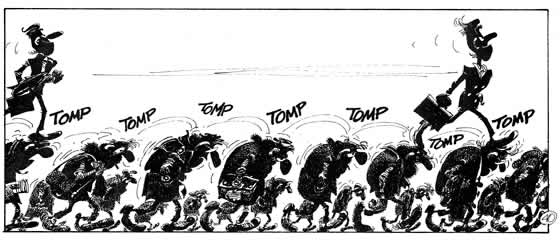

I did however find some racist colonial stuff from his very early works (1950). I won’t like, it’s quite bad. However the 1950 stuff is ignorant & insensitive racist colonial fuckery from a then 26 year old author who later denounced it and tried to make up for it, while the 2023 stuff is very intentional dogwhistling to modern day racists from boomers who should really know better. It’s unfathomable that Dupuis would have greenlighted such backwards stuff in the modern age.
Not a very hot take, only corpo bootlickers pretend that Nintendo isn’t squandering the franchise.
It’s supremely frustrating that franchises like these get enshittified to hell and there’s fuck-all anyone can do about it if they are not willing to work completely for free (i.e. fanfiction writers). Same with the Star Wars content mill which also went to shit while we’re forced to sit and watch or give up on the franchise entirely. Or LoTR which in the past 20 years only gave us The Hobbit (🤮) and the Amazon show (🤮🤮).
Human stories were meant to be evolved and expanded on; that’s how all of our ancestors built a rich tapestry of myths and folklore over generations, constantly retelling and updating stories. But we aren’t allowed to.
I’m Belgian. My grandparents, my parents, my cousins and my cousin’s children all grew up reading Belgian comics such as Tintin, Spirou&Fantasio, Lucky Luke, the Smurfs, etc, which were written in the mid-20th century. Yet if any of them publishes anything set in those universes they’ll get sued into the ground, so instead these important cultural works are left to rot and wither and be slowly forgotten by each subsequent generation while the Estate shits out a soulless (if not outright racist and sexist which shits on everything that Franquin ever stood for) reboot that no-one cares about every 15 years or so. Such a sad end for such important cultural landmarks that used to be the pride of our country.
Copyright should last 25 years, just like patents. That’s more than enough time to recoup your initial investment and doesn’t prevent you from making money after then, you’ll just have to compete for it on the marketplace of ideas. Isn’t that what capitalists should want?
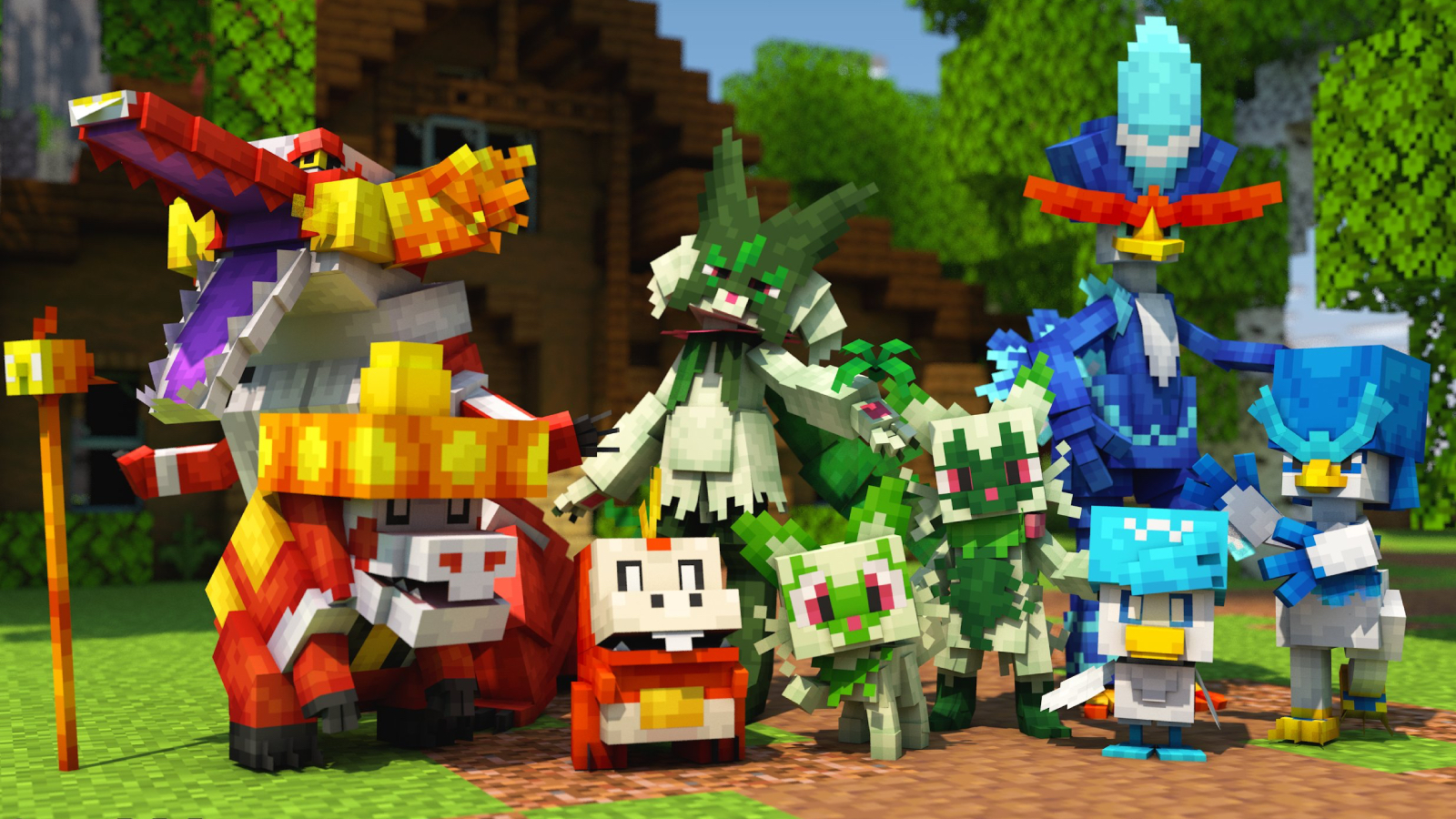
Cobblemon is a pokémon mod for minecraft, and definitely has a charm to it and fits weirdly well into the minecraft-pixel-art-with-shaders esthetic IMO. Plus the “gotta catch em all” basic gameplay loop meshes well with Minecraft’s incentive to explore the world.
Of course it’s a free mod so it’s a bit rough around the edges and there doesn’t seem to be much to do beyond collect pokémon and build minecraft houses, but in my online circles it certainly has captured a lot more attention than any pokémon game released in the last forever. I would like to think Nintendo is taking notes, but we all know they Don’t Give A Fuck. They’ll pump out any asset flip and people will buy it because they’re nostalgic and Nintendo has a legally enforced monopoly on the franchise.
There’s not a bunch of full frontal nudity or raunchy sex scenes, that’s true.
But the game is shamelessly horny. All characters were designed to be maximally fuckable and they’re all desperately tryna fuck. The sexual tension is palpable and several of the MC outfits wouldn’t be out of place at a sex party.
Don’t get me wrong I wouldn’t call the game softcore porn by any stretch, it’s just… canonically horny. Which is perfectly fine.
I’ve always despised teen drama in media. Back when I was a teen, and now. Can’t stand it. For that reason, I have zero interest in playing the sequels. Furthermore, some of Life is Strange’s writing is downright amateurish.
But somehow, the game threads the needle of the formula in a way I can’t explain (and from what I read the developers weren’t ever able to fully replicate it either). The gameplay, the themes, the great acting/directing, the amazing soundtrack, the perfectly paced escalation of the stakes… It all works together to attach the player very deeply to the characters. I played it a decade ago and the ending absolutely shook me to my emotional core. To this day one of my favorite works of fiction.
It can either work very well or terribly I think.
It would have been terrible in TW3. There are too many damn quests to keep track of; when you get to Novigrad you spend the first couple hours being bombarded by quest hooks, some of which are not supposed to be resolved until Geralt gains 10 more levels (for instance Hattori’s quest line). Having to turn down a quest hook or fail a quest because of time constraints would be punishing through no fault of the player and therefore bad game design. Book Geralt would ignore all the side-quests and focus on finding Ciri, but that’d make for a very different game. Also 75 % of the quest hooks where you’re supposed to meet someone “at the docks tonight” are just a narrative shortcut. In real-life you’d say “sorry I already have a nightwraith contract, can you do tomorrow night instead?”.
If the reasons why you have to turn down a quest are well integrated to the narration and the player can only fail a quest because of actual time mismanagement, then it makes sense. IMO this seems most doable in a game with a reduced scope, up to 20 hours of content, where every quest is distinct and meaningful and can be kept in mind. Which I’m very down for because I don’t have much time for 100+ hour main story games anymore.
Honestly the metro design language didn’t look particularly attractive for touch screens either. I knew someone with a Nokia Windows Phone, the interface seemed… clunky. Quirky but not in the right ways.
It has to cater to mice and fingers, and so ends up with the lowest common denominator. Can’t have information density because of the butter fingers, can’t have neat swiping gestures because of the mice and especially trackpads. So, big squares and huge buttons, repeat ad nauseum. Like a DUPLO set.
Surely the UI/UX designers and Microsoft knew this, but I guess Ballmer had his way. Meanwhile Valve didn’t have to contend with cranky executives, so they just slapped Big Picture on top of KDE and let use decide when to switch between console mode and desktop mode.
Ooooh but with Starfield they called it “Creation Engine TWO”, you see.
The least well-kept industry “secret” is that the major version number of a hidden technical component literally doesn’t matter as soon as you hear it because the marketing people will get their grubby little hands on it and force an update whenever they need to capitalize on some kind of wow effect.
“CE2” is clearly barely any better or different than skyrim or fallout’s CE; in fact as far as I can tell the script extender dropped pretty much immediately after the game’s release, which clearly indicates no major architectural change to work around. Also if Bethesda really did enough work to warrant a “version 2” why the hell are there loading screens everywhere like it’s 2008.
Skyrim 32 bit to Skyrim 64 bit was probably a much bigger generational leap than anything Bethesda has done since then.
As a developer I believe “just rewrite it from scratch” is a cardinal sin and a beginner’s mistake in 95 % of cases. Creation Engine though? They are clearly carrying around technical debt that was already very dated 15 years ago, like the constant loading screens. Now the loading screen look soooo bad it’s a complete meme yet they don’t seem capable of fixing that. At least apparently they managed to get rid of the FPS lock with Starfield? Only 20 years too late.
Cease&desist every casino would be a good first step. Casinos are well outside the original intended purpose and if the ToS don’t prohibit their existence that can easily be changed. Valve doesn’t owe anyone the right to gamble their items, especially not with the weird third party escrow system that casinos use IIRC.
But if we’re touching on the subject then we need to reopen the contentious subject of the lootboxes themselves, which are gambling. Which Valve (and the video game industry) has an enormous stake in. To fix that whole mess, I expect a government crackdown will be required.
You’ll have a hard time finding a jurisdiction where minors gambling (even behind the veil of “we don’t check who our customers are”) is legal. The “IRL item gambling” site in the video was in fact blatantly illegal in Denmark despite the lengths to which they went to pretend “it’s not gambling because the house always loses”.
Asking Valve to police gambling is the next best thing to do if governments won’t step in. You say it like it’s an impossibility, ignoring the fact that “state-run gambling” is quite a common setup. In France for instance all money games are run by la française des jeux, a state-owned monopoly whose profits are meant to go to charity. In the US it wouldn’t be a crazy idea either, given how many US states already have state-run monopolies for alcohol sales for example. It’s not like historical precedent is lacking to show that regulating a parasitic industry is possible…
Maybe you can find examples of other industries that are heavily infected with gambling bullshit, but that’s whataboutism and in no way relevant to the discussion.
I didn’t play TW3 right on launch but CP77 was… fine, on PC. Played it day one, nothing game-breaking.
However four years later the open world still disappoints compared to the masterclass that was TW3. The world feels smaller, the driving sucks ass, and NC doesn’t feel nearly as lively or polished as Novigrad (though it is gorgeous and I did have a great time).
Even two years later, CP2077 was a technical regression from TW3. Bugs aside, can CDPR really pull it together and improve upon TW3 and not repeat the mistakes of CP2077, despite having to learn entirely new engine? I wouldn’t bet too much on it.
Drawings are one conversation I won’t get into.
GenAI is vastly different though. Those are known to sometimes regurgitate people or things from their dataset, (mostly) unaltered. Like how you can get Copilot to spit out valid secrets that people accidentally committed by typing
NPM_KEY=. You can’t have any guarantee that if you ask it to generate a picture of a person, that person does not actually exist.